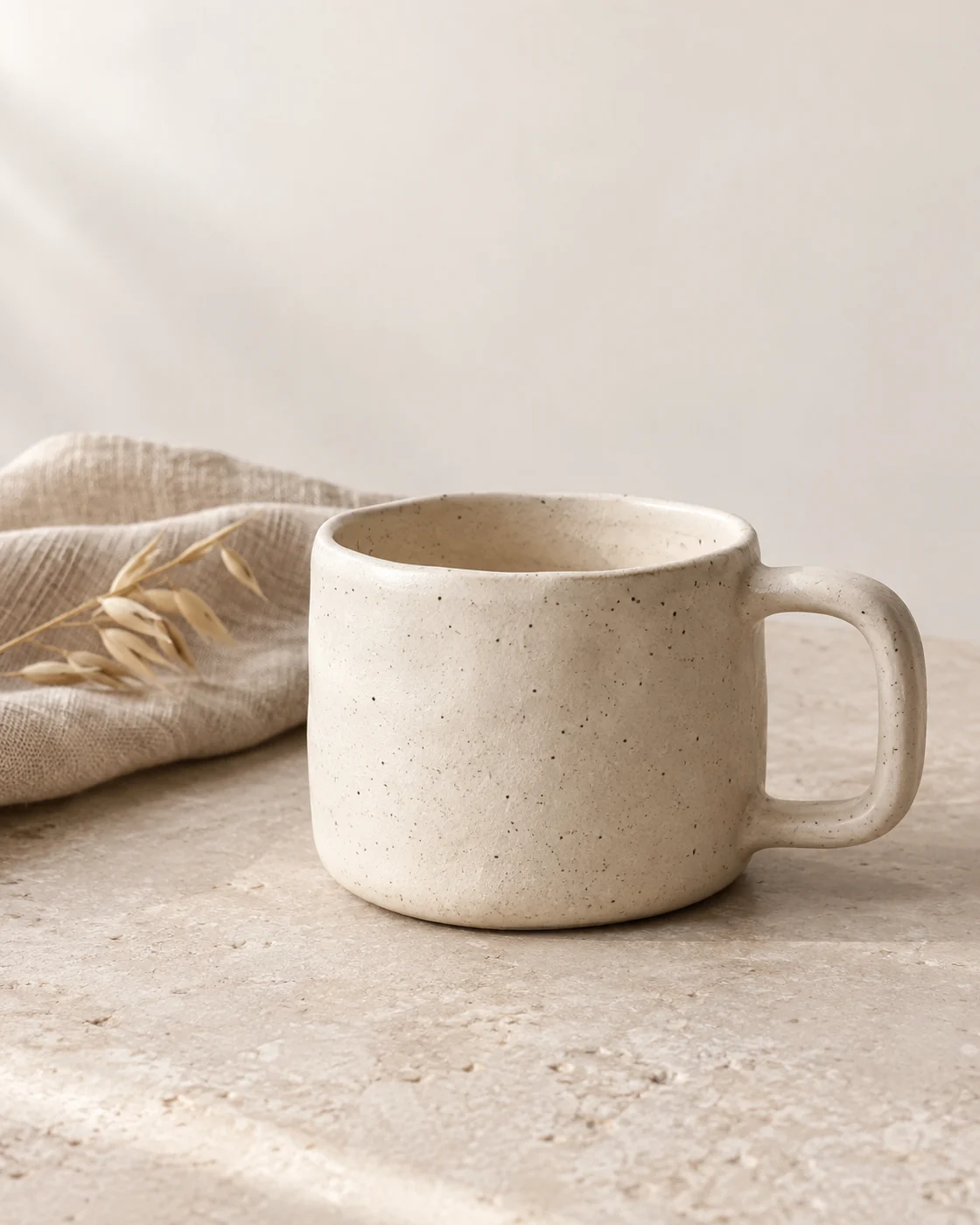

This AI product photography prompt creates a 4:5 advertising image for an original handmade ceramic mug concept. You can copy the tested English prompt, swap the product and material fields, or keep the mug fixed while changing the background and light. The article also includes a complete Korean prompt that was generated in a separate ChatGPT conversation.
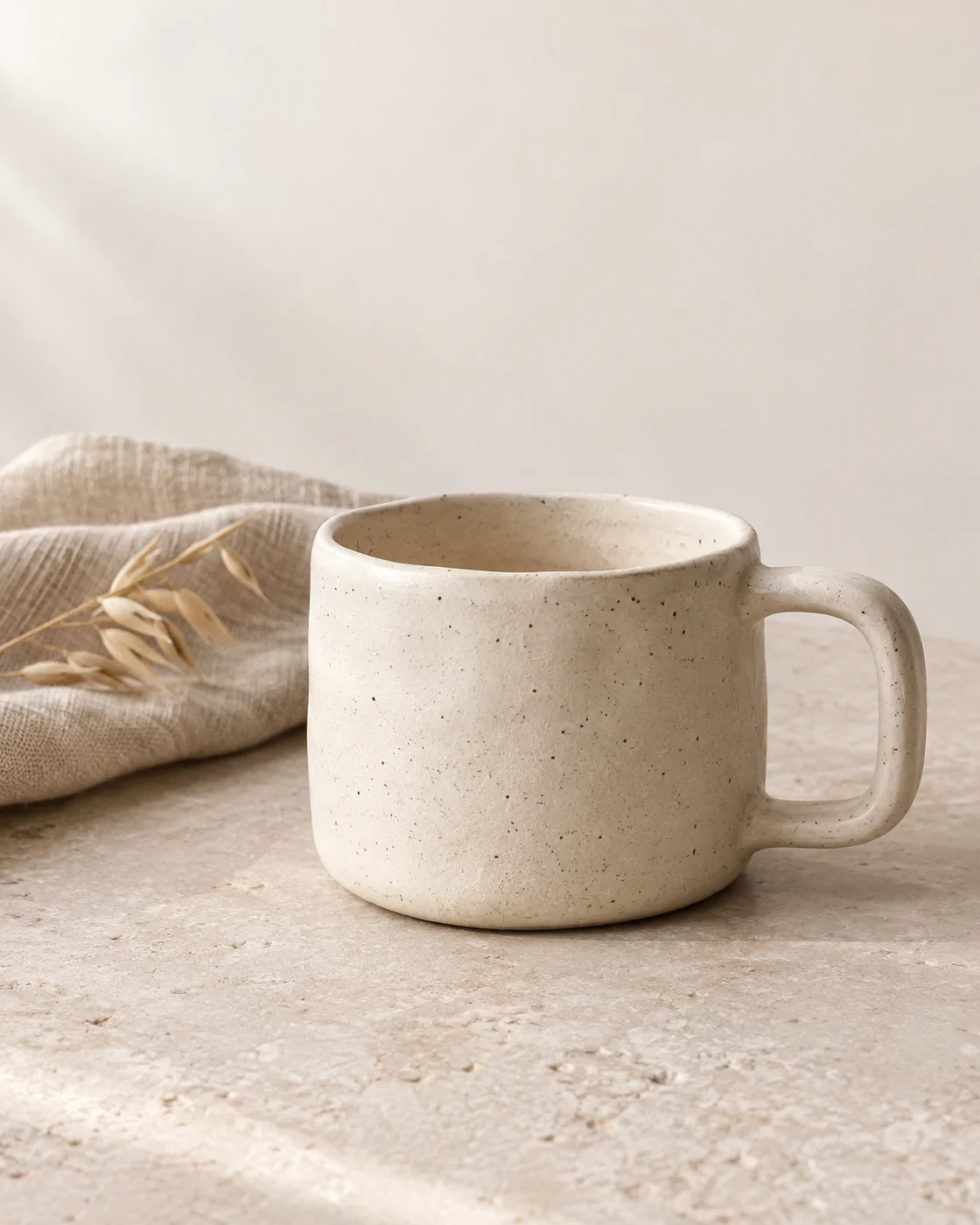
This setup is useful when you need a product concept for a pitch, social post, or visual direction before a physical sample exists. It is not a substitute for an accurate listing photo of something you already sell. If the handle curve, glaze pattern, color, or dimensions must match a real item, attach a product photo you have permission to use and tell the editor which parts must stay unchanged.
Can ChatGPT make a usable product concept from this prompt?
Yes. The first run created one low, wide mug with a rounded-square handle, speckled ivory glaze, pale limestone, folded linen, and a single oat stem. The handle joined the body cleanly, no extra product appeared, and the generous upper-left space left room for an ecommerce headline or crop.
- Open ChatGPT on the web and select the image creation option shown in your interface.
- Copy the complete English prompt below and send it without shortening the constraints.
- Check the product shape, handle, surface, prop count, and aspect ratio at full size.
- When you like the layout, continue in the same conversation to change the background or lighting.
OpenAI’s image generation guide recommends specifying the purpose, subject, setting, composition, and lighting. It also recommends separating what should change from what should remain fixed during an edit. The prompt below keeps those instructions in distinct blocks so individual fields are easier to replace.
Copy the complete AI product photography prompt
This is the exact prompt used for the bright image above. It was saved before the result was assessed and was not reconstructed afterward.
Create one image only.
Asset type: a 4:5 vertical e-commerce hero image for an original handmade ceramic mug concept.
Primary subject: exactly one unbranded handmade stoneware mug. Give it a low, wide cylindrical body, a rounded-square handle on the right, a slightly irregular hand-finished rim, and a warm ivory matte glaze with sparse charcoal speckles. The mug is empty and completely clean. No text, logo, stamp, or maker's mark.
Composition: three-quarter front view from slightly above tabletop height. Place the mug just right of center with the full handle visible. Leave calm negative space in the upper-left. Keep the entire mug inside the frame. Use a restrained editorial product-photo crop, not a flat catalog cutout.
Scene: pale honed limestone tabletop, warm off-white seamless background, one loosely folded piece of natural beige linen behind and to the left of the mug, and one short dried oat stem resting on the linen. No other props.
Lighting: soft late-morning window light from the upper-left, gentle natural falloff, a clean contact shadow under the mug, low contrast, and neutral-warm white balance.
Material detail: believable stoneware thickness, fine matte glaze, subtle handmade asymmetry, visible woven linen fibers, lightly porous limestone, realistic shadow and edge transitions.
Output: exact 4:5 portrait ratio, high-resolution photorealistic commercial product photography.
Constraints: preserve physically plausible mug and handle geometry; exactly one mug and one handle; no duplicate objects; no liquid; no steam; no hands or people; no flowers; no food; no packaging; no readable text; no logo; no watermark; no border; no collage; no illustration; no CGI look; no exaggerated depth of field; no dramatic color grading.
Which parts should you replace for another product?
Change one block at a time. A different product usually requires a new shape and material description as well as a new noun. If you replace only mug, its handle and empty interior can survive in the next image.
| Field | Find this text | Possible replacement | Check before sending |
|---|---|---|---|
| Product | handmade stoneware mug |
matte glass candle jar or small ceramic vase |
Remove the mug handle and empty-interior instructions when they no longer apply |
| Body shape | low, wide cylindrical body |
tall tapered body |
Make the rim, base, and handle proportions agree with the new shape |
| Color and finish | warm ivory matte glaze |
deep cobalt glossy glaze |
Update the reflection instructions and remove the speckles if needed |
| Surface | pale honed limestone tabletop |
light oak tabletop or matte charcoal slate |
Keep a believable contact shadow on the new material |
| Props | natural beige linen and dried oat stem |
folded gray cotton and small eucalyptus twig |
Replace old props instead of adding more on top of them |
| Aspect ratio | exact 4:5 portrait ratio |
1:1 square ratio or 16:9 landscape ratio |
Recheck the product size and negative space after the crop changes |
Example: replace the mug with a candle jar
Replace handmade stoneware mug with matte glass candle jar, then delete rounded-square handle on the right. Replace the empty-interior instruction with flat unlit cotton wick centered in smooth ivory wax. This candle version is an editing example, not one of the generated results in this article.
Use a reference photo when the real product must match
The tested text prompt invents a product concept. For a real listing, upload a photo you are allowed to use and state that the product silhouette, proportions, color, surface pattern, label, and camera angle must remain fixed. Then ask for a background edit. A text-only concept can differ from the item a customer receives, even when the prompt sounds precise.
How do you change the background without redesigning the mug?
The second image was made in the original English conversation. The edit replaced the pale limestone and warm white background with dark slate and charcoal, then changed the soft window light to a focused warm side light. The mug, camera, linen, oat stem, and negative space were listed as fixed elements.
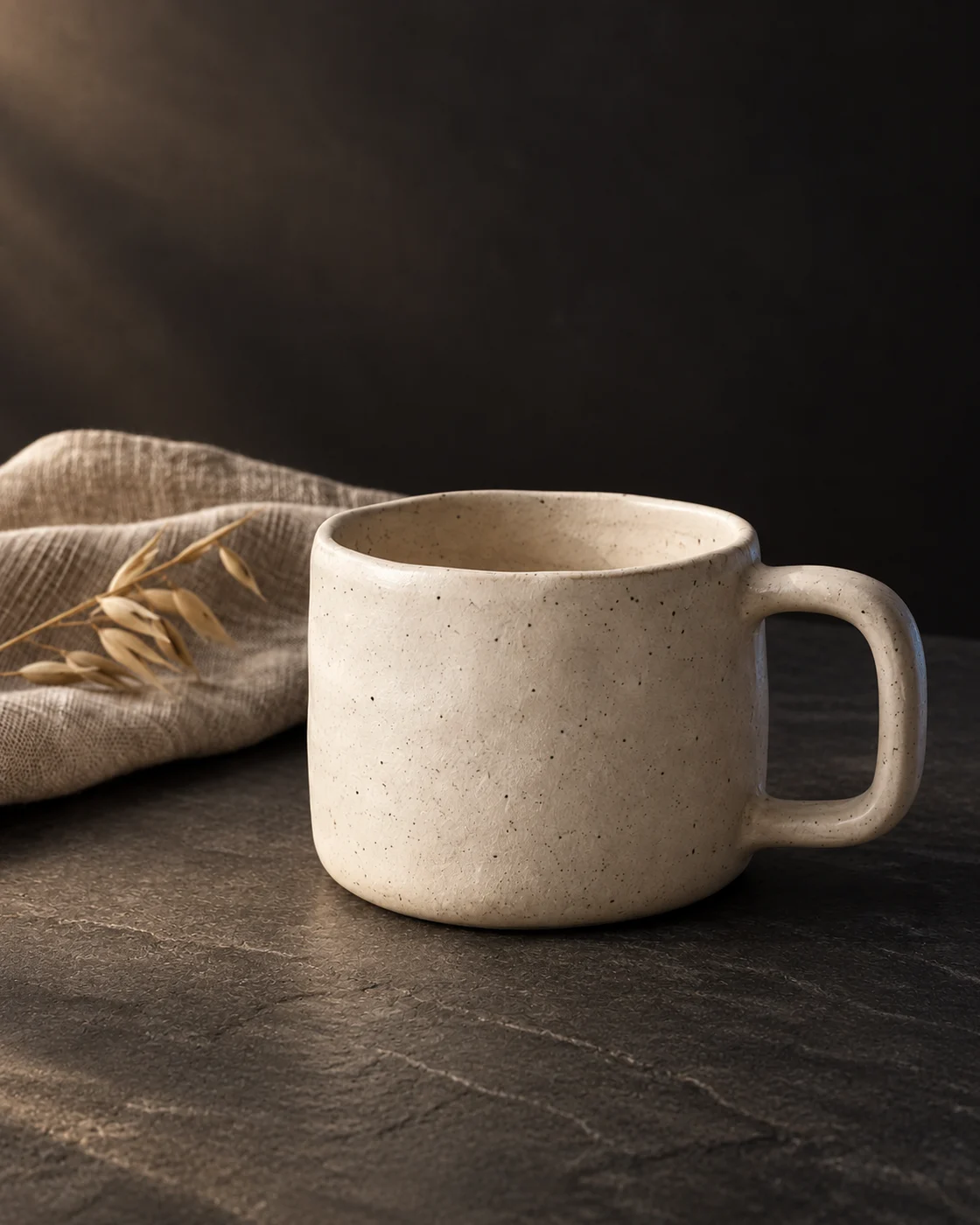
Send the following text in the conversation that contains the bright source image. A new conversation has no image to preserve and will create a new mug instead.
Edit the generated image as a controlled background-and-lighting variation.

Change only these variables:
1. Replace the pale limestone tabletop and warm off-white seamless background with a matte charcoal slate tabletop and a smooth near-black charcoal gradient background.
2. Replace the soft late-morning window light with a focused warm side light from the upper-left and a very subtle cool edge light along the mug's right side. Keep the scene low-key but retain visible detail in the ivory glaze and handle.

Keep unchanged: the exact 4:5 crop, camera position, three-quarter viewing angle, mug size and placement, low wide cylindrical body, rounded-square handle on the right, slightly irregular rim, warm ivory matte glaze, charcoal speckles, empty interior, linen shape and position, dried oat stem and its position, negative space, product scale, and photorealistic product-photo treatment.

Constraints: do not move, rotate, resize, duplicate, remove, or redesign the mug, linen, or oat stem; exactly one mug and one handle; no liquid; no steam; no hands or people; no new props; no readable text; no logo; no watermark; no border; no collage; no illustration; no CGI look; preserve realistic contact shadows and material texture.| Variable | Bright original | Dark edit | Observed change |
|---|---|---|---|
| Surface | Pale honed limestone | Matte charcoal slate | The tabletop became darker and more textured |
| Background | Warm off-white | Near-black charcoal gradient | The upper negative space became a low-key ad background |
| Light | Soft late-morning window light | Focused warm light from the left | Contrast increased across the mug and tabletop |
| Fixed layout | Crop, camera, mug shape and position, handle, glaze, linen, and oat stem | The major placement remained stable | |
| Small drift | Speckles, linen fibers, grain heads, and shadows were not pixel-identical | Fine surfaces were reinterpreted during the generative edit | |
Bonus: copy the tested Korean prompt
The Korean version below was sent on its own in a fresh ChatGPT conversation. It produced the same product specification and bright tabletop setup, although the fresh generation changed the mug’s scale and the exact prop positions.
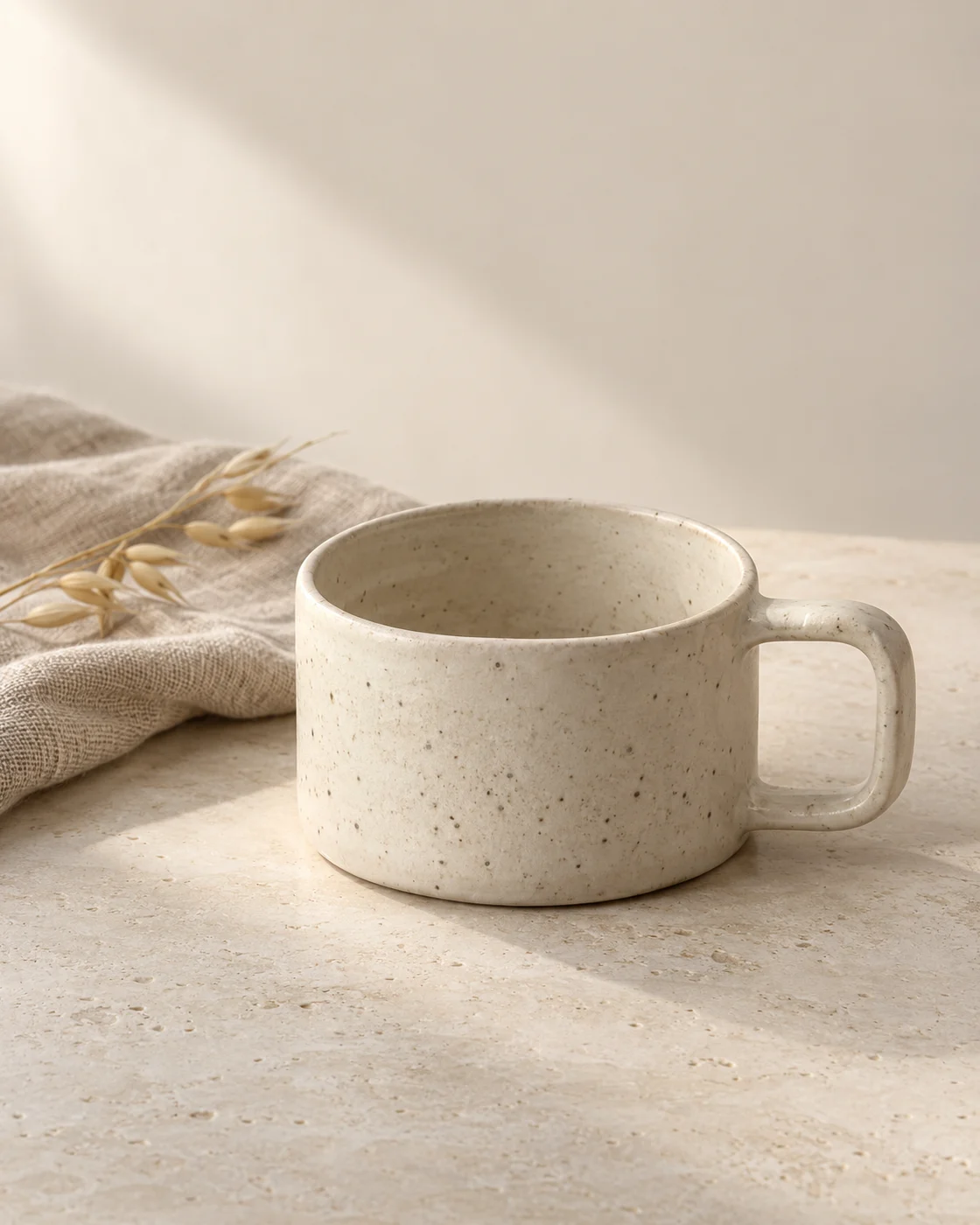
이미지 한 장만 생성하세요.
에셋 유형: 독창적인 수제 도자기 머그컵 콘셉트를 보여주는 4:5 세로형 온라인 쇼핑몰 대표 이미지.
주요 제품: 상표가 없는 수제 스톤웨어 머그컵 한 개만 배치하세요. 낮고 넓은 원통형 몸체, 오른쪽의 둥근 사각형 손잡이, 손으로 다듬어 살짝 불규칙한 테두리, 드문드문 짙은 회색 점이 있는 따뜻한 아이보리색 무광 유약을 적용하세요. 머그컵은 비어 있고 완전히 깨끗해야 합니다. 글자, 로고, 도장, 제작자 표시는 넣지 마세요.
구도: 테이블 높이보다 약간 높은 위치에서 바라본 정면 3분의 2 시점. 머그컵은 중앙보다 조금 오른쪽에 놓고 손잡이 전체가 보이게 하세요. 왼쪽 위에는 차분한 여백을 남기고 머그컵 전체가 프레임 안에 들어오게 하세요. 평면적인 카탈로그 누끼 사진이 아니라 절제된 에디토리얼 제품 사진 구도를 사용하세요.
장면: 밝고 매끈하게 연마된 석회석 상판, 따뜻한 미색의 이음매 없는 배경, 머그컵 뒤쪽 왼편에 느슨하게 접힌 천연 베이지색 리넨 한 장, 리넨 위에 놓인 짧은 마른 귀리 줄기 한 개. 다른 소품은 넣지 마세요.
조명: 왼쪽 위에서 들어오는 부드러운 늦은 오전의 창문 빛, 자연스럽고 완만한 빛의 감소, 머그컵 아래의 또렷하면서 부드러운 접촉 그림자, 낮은 대비, 중립에 가까운 따뜻한 화이트 밸런스.
재질 표현: 자연스러운 스톤웨어 두께, 고운 무광 유약, 수제품다운 미세한 비대칭, 눈에 보이는 리넨 섬유, 약간 다공성인 석회석, 현실적인 그림자와 가장자리 전환.
출력: 정확한 4:5 세로 비율, 고해상도의 사실적인 상업 제품 사진.
제약 조건: 머그컵과 손잡이의 구조는 물리적으로 자연스러워야 합니다. 머그컵 한 개와 손잡이 한 개만 있어야 합니다. 복제된 사물, 액체, 김, 손이나 사람, 꽃, 음식, 포장, 읽을 수 있는 글자, 로고, 워터마크, 테두리, 콜라주, 일러스트, CGI처럼 보이는 표현, 과도한 아웃포커싱, 극적인 색 보정을 넣지 마세요.
Which instructions had a visible effect?
The shape instructions did more useful work than generic quality labels. low, wide cylindrical body set the mug’s proportions, while rounded-square handle on the right fixed the handle’s shape and direction. At full resolution, both English images had a continuous rim and a handle connected to the body at two believable points.
The material descriptions separated the surfaces. The mug used fine matte glaze, the cloth used visible woven linen fibers, and the tabletop used lightly porous limestone. The result did not need a long string of quality buzzwords to make those surfaces readable.
Prop limits helped too. The scene allowed one folded linen piece and one short oat stem, followed by No other props. All three results kept the product visually dominant and did not add food, flowers, packaging, or stray text.
What should you change if the handle or product count is wrong?
No handle or duplication failure occurred in the three published results. The lines exactly one mug and one handle and no duplicate objects are preventive constraints, not a claim that those defects appeared during testing.
If the handle joins the body awkwardly, replace the shape line with a rounded-square handle attached cleanly at two points on the right side. Continue in the conversation containing the best result and ask to repair only the handle. Starting over can change the mug, crop, and props at the same time.
If an ivory product disappears against a dark background, state what must remain visible. The edit used retain visible detail in the ivory glaze and handle. The result preserved detail inside the handle and added only a faint cool edge on the right side.
How was this prompt verified?
- Date: September 5, 2026 KST
- Tool: signed-in ChatGPT web
- Observed interface label:
이미지 만들기, meaning image creation - Internal model name: not shown in the interface and therefore not claimed
- Downloads: three 1122 by 1402 PNG files
- Web images: three 1120 by 1400 WebP files in an exact 4:5 ratio
- Attempts: one English original, one controlled edit, and one independent Korean generation
- Rejected outputs: none
The pattern was discovered through case 373 in awesome-gpt-image-2, which separates a commercial product, surface, background, and lighting into editable fields. Its Chinese prompt and image were not copied or used as generator input. The collection lists a post by @xpg0970 as the original source.
For a less polished, everyday camera style, compare the earlier ChatGPT prompt for a candid phone photo. It uses an accidental crop and documentary details instead of a controlled product setup.
Common questions
Can I use the Korean prompt instead of the English version?
Yes. The Korean prompt above produced the requested mug, glaze, limestone, linen, oat stem, and bright window light in a separate conversation. Use the language you can edit accurately. Neither version guarantees the same pixel arrangement on a fresh generation.
Can I use a text-only image for a real ecommerce listing?
Use it as concept art unless it matches the item customers will receive. For a real listing, attach a product photo you have permission to use and preserve the product identity while editing the surroundings. Check the final color, dimensions, label, and product details against the physical item.
Can ChatGPT keep the same product and change only the background?
It can preserve the main product and layout when the edit happens in the source image’s conversation. Separate the request into changed and fixed fields. Fine details such as glaze speckles, cloth fibers, and shadows may still be reinterpreted.
How do I adapt the prompt for cosmetics or a candle?
Replace the product noun, geometry, surface, and any product-specific constraints together. Delete the mug handle and empty-interior instructions when they do not apply. Keep the camera and background blocks unchanged if you want to isolate the new product.
Run the original once before editing it. On the next request, change either the product or the background, then inspect the result at full size before adding another variable.